

How Robotic Surgery Is Changing Pediatric Urology: Insights from Dr. Prabhu Karunakaran
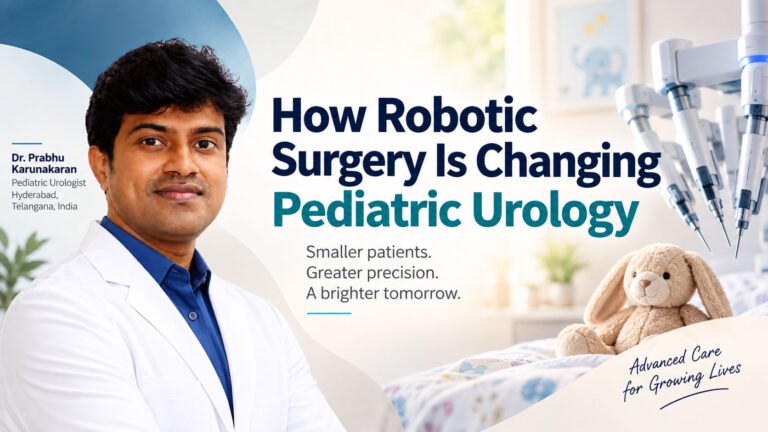
When a surgical procedure involves an infant weighing only a few kilograms, precision becomes a completely different challenge.
That was one of the central themes of a recent Key Opinion Leader (KOL) interview on the MedSynapse YouTube channel featuring Dr. Prabhu Karunakaran, Pediatric Urologist from Hyderabad, Telangana, India.
In the discussion, Dr. Prabhu Karunakaran shared insights from a particularly challenging case involving a 2.5-month-old infant weighing approximately 4–5 kg and explained why robotic assistance was considered for the procedure. The conversation also examined the technical adaptations needed in very small children, what current evidence suggests about outcomes, and where robotic surgery could have a growing role in pediatric urology.
When an Infant Needs Surgery, Why Consider a Robotic Approach?
The case discussed by Dr. Prabhu Karunakaran involved Pelvi-Ureteric Junction Obstruction (PUJO) affecting the child’s right kidney. For the surgical team, the question was not simply whether the condition could be treated. It was how to achieve the necessary precision while limiting the invasiveness of the procedure. Dr. Prabhu Karunakaran compared the three approaches discussed in the interview: open, laparoscopic, and robotic surgery.
Open surgery provides direct three-dimensional visualization and allows the surgeon to physically feel and handle the tissues. Those are significant advantages when operating precisely. The trade-off is the larger incision required to access the kidney. Laparoscopic surgery offers a minimally invasive route with smaller access points, but conventional laparoscopy has limitations. The surgeon works with two-dimensional visualization and instruments with more restricted movement.
Robotic Surgery, according to Dr. Prabhu Karunakaran, combines key advantages of open and laparoscopic approaches, including 3D visualization, magnification, stability, and articulated instrument movement. He describes this as giving the surgeon “bigger eyes” and “smaller hands” inside the operative field—an advantage when working with the very small anatomy of infants.
What Changes When the Patient Weighs Only a Few Kilograms?
Robotic surgery does not simply involve placing smaller patients under the same setup used for adults. The anatomy itself changes the way the operation has to be planned.
In the case discussed in the interview, the child was around 2.5 months old and weighed between 4 and 5 kg. Dr. Prabhu Karunakaran identified the child’s size and weight as major technical considerations.
Before discussing the equipment, however, he emphasized the importance of specialized pediatric expertise.
The surgeon needs to be comfortable working with very small anatomical structures and handling delicate tissues with exceptional precision. Dr. Prabhu Karunakaran stressed that the experience of the surgeon remains critical even when advanced robotic technology is available.
What Makes Robotic Surgery in Infants Technically Challenging?
Another challenge is port placement.
A typical robotic setup requires multiple ports for the camera and instruments. In a very small child, the available space can make it difficult to position those ports far enough apart.
Dr. Prabhu Karunakaran explained that when the distance between ports becomes too small, the robotic arms outside the body may interfere with one another. He discussed a spacing of approximately 6 cm as an important consideration in the setup described.
This is where “burping” the ports can become useful.
As explained in the interview, the abdominal wall can be lifted or tacked around the ports to create additional working space externally. Simply increasing the gas pressure inside the abdomen is not the preferred answer in a small child, because the child may not tolerate higher pressure and the diaphragm can be affected.
These details illustrate how pediatric robotic surgery depends on adapting the entire setup to the child’s anatomy rather than simply applying an adult surgical template.
Does Robotic Surgery Offer Better Outcomes in Children?
The next question in the MedSynapse interview focused on a concern many families and clinicians may have: How safe is robotic surgery in very young children, and does it actually produce better outcomes?
Dr. Prabhu Karunakaran explained that the available evidence discussed in the interview suggests that open, laparoscopic, and robotic surgery have broadly comparable outcomes. He also made it clear that additional research is still needed before stronger conclusions can be drawn. That is an important distinction. The value of robotic surgery may not necessarily be that it produces a completely different surgical outcome. Its appeal can also come from the way it enables the surgeon to perform the operation.
The robotic system provides:
Three-dimensional visualization for improved depth perception. Magnification that allows a highly detailed view of the operative field. Articulated instruments that provide greater flexibility at the instrument tip. Instrument stability, which can be particularly useful for delicate work in confined spaces.
Recovery after surgery
Dr. Prabhu Karunakaran highlighted low postoperative pain and early activity as potential benefits of robotic surgery in his experience. He noted that children, including the infant discussed, may be active within around 48 hours. However, he also emphasized that more rigorous research, including randomized controlled trials, is still needed to strengthen the evidence.
Which Pediatric Urological Procedures Could Benefit From Robotics?
Robotic surgery in pediatric urology is not limited to kidney procedures.
When discussing future applications, Dr. Prabhu Karunakaran identified a range of conditions and procedures where robotic assistance may be particularly useful.
These included:
- Pelvi-Ureteric Junction Obstruction (PUJO)
- Vesicoureteral reflux
- Bladder augmentation
- Mitrofanoff procedures
- Bladder neck surgery
- Other complex bladder procedures
- Pediatric transplantation
A common theme is the need to work precisely in relatively restricted anatomical spaces.
The interview also touches on why robotic surgery has historically found a strong role within urology. Dr. Prabhu Karunakaran explained that adult urologists adopted robotics for procedures involving deep pelvic anatomy, where open access can require larger incisions and greater tissue disruption.
Some of those same principles can be relevant in pediatric urology, where precise control and visualization may be especially valuable.
That does not mean robotics is automatically preferable for every child or every procedure. The right approach still depends on the individual case, the procedure being performed, and the expertise available.
What Could the Future of Pediatric Robotic Surgery Look Like in India?
The technology may be advancing quickly, but specialist expertise remains a major part of the equation.
Dr. Prabhu Karunakaran pointed out that pediatric robotic surgery is relatively new in India compared with more established international programs. He also highlighted the limited number of doctors practicing exclusively in pediatric urology.
During the interview, he estimated that there may be only around 10–12 dedicated pediatric urologists across the country, using that figure to illustrate the need for greater specialist capacity.
For robotic pediatric surgery to expand meaningfully, more specialists will need exposure to both pediatric urology and robotic techniques. This is why the future is not simply about adding more robotic systems to hospitals It is about developing the people who can use them effectively.
As Dr. Prabhu Karunakaran emphasized throughout the conversation, the expertise behind the technology matters enormously. Training, pediatric surgical experience, precise tissue handling, and familiarity with the robotic platform all contribute to the quality of care.
The Bigger Picture
The MedSynapse conversation with Dr. Prabhu Karunakaran highlights that robotic pediatric surgery is about more than technology. In very young patients, precise planning, instrument placement, and tissue handling are critical. Robotic systems can enhance visualization, magnification, stability, and dexterity, but these benefits depend on specialized pediatric expertise and careful patient selection as robotic surgery continues to evolve in India.