

Understanding Hypospadias in Children - Dr Prabhu Karunakaran, Pediatric Urologist Hyderabad
Hypospadias is a common condition seen at birth—and when treated correctly and at the right time, children go on to have normal urinary function and a healthy life. For many parents, the diagnosis raises immediate questions and concerns. Understanding the condition clearly helps replace fear with confidence.
What Is Hypospadias?
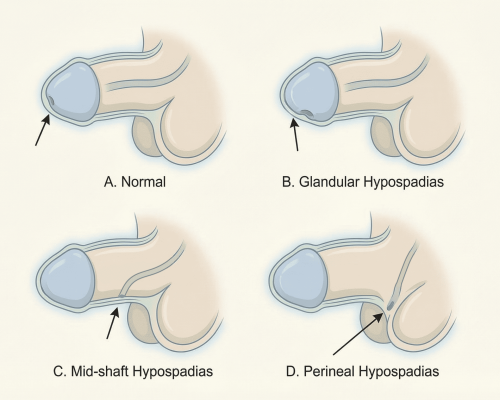
Hypospadias is a condition in which the urinary opening is not located at the tip of the penis at birth.
Instead, the opening is found on the underside of the penis.
The severity of hypospadias depends on how far down the opening is located—the further away from the tip, the more complex the condition.
In many children:
- The foreskin is incomplete on the underside
- This gives the penis a typical hooded appearance
Why Does Hypospadias Occur?
Hypospadias develops during early pregnancy when the penis and urinary tube are forming.
This process depends on a male hormone called dihydrotestosterone (DHT).
If:
- The hormonal effect is inadequate, or
- The tissues do not respond properly to the hormone
the urinary tube does not form completely, resulting in hypospadias.
Hypospadias occurs in approximately 1 in every 250 boys.
Risk may be higher when:
- A close family member has hypospadias
- Certain environmental factors are present
- Assisted reproductive techniques are used
Hypospadias Diagnosis
In most cases, hypospadias is diagnosed by a physical examination at birth. The position of the urinary opening, the appearance of the foreskin, and the presence of any penile curvature are assessed.
A pediatric urologist may further evaluate:
The exact location of the urethral opening
The degree of penile curvature (chordee), if present
Because hypospadias can be associated with other conditions, the child is also examined for:
Undescended testis
Inguinal hernia
Hypospadias is not a life-threatening condition. However, if left untreated, it may lead to difficulties with urinary function, abnormal urinary stream, and potential concerns related to genital appearance and self-confidence later in life.
Why Is Treatment Important?
Children with untreated hypospadias may experience:
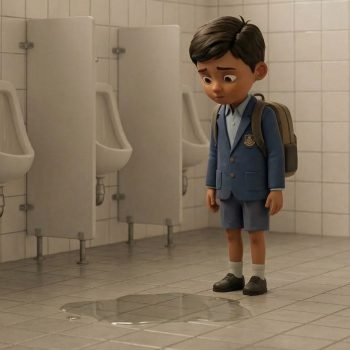
- Difficulty passing urine while standing
- An abnormal or spraying urine stream
- Penile curvature (chordee), which may cause issues in adulthood
Early correction helps prevent physical, functional, and psychological concerns as the child grows.
Treatment of Hypospadias
Hypospadias is treated with surgery, with excellent outcomes when performed by an experienced pediatric urologist.
The goals of surgery are to:
- Create a normal urinary passage
- Bring the urinary opening to the tip of the penis
- Correct any penile curvature
The foreskin is often needed for reconstruction.
Therefore, Circumcision should not be done before hypospadias surgery.
When Is the Best Time for Surgery?
The recommended age for surgery is between 6 and 18 months.
Surgery during this period allows:
- Better healing
- Minimal psychological impact
- Excellent long-term cosmetic and functional results
In most cases, surgery performed by an experienced pediatric urologist results in best function and appearance.
Key Takeaways for Parents
- Hypospadias is a common condition present at birth
- Severity depends on how low the urinary opening is positioned
- It is not life-threatening but can affect quality of life
- Surgery is the definitive and effective treatment
- Best surgical age is 6–18 months
- Early diagnosis and expert care by a trained pediatric urologist ensure excellent outcomes
Yes. Hypospadias varies in severity. Mild forms have the urinary opening close to the tip, while severe forms are located further down.
Surgery is generally recommended because even mild cases can affect urinary stream or cause issues later in life.
Yes. After a successful surgery, most children achieve a straight urine stream and are able to urinate normally while standing.
In most cases, a single surgery is sufficient. More complex or severe forms may occasionally require staged procedures, depending on the anatomy.
In most cases, hypospadias surgery is performed as a short hospital stay or day-care procedure. The child usually goes home the same day or within 24 hours, depending on the type of repair and postoperative care plan.

Book an Appointment with Dr. Prabhu Karunakaran
For consultations and appointments:
 Visit: https://drprabhukarunakaran.com/appointment/
 Book on WhatsApp: 8500550328 (or)
  Call for details: 8500550328
Get expert advice and the best treatment options for your child’s kidney and urinary health from Hyderabad’s only dedicated Pediatric Urologist.