

Testicular Torsion in Children: A Medical Emergency | Dr. Prabhu Karunakaran, Pediatric Urologist in Hyderabad
Sudden testicular pain can be frightening—for both children and parents. While some causes may be minor, one condition demands immediate attention: testicular torsion. This is a time-critical emergency where early action can protect your child’s health, future fertility, and peace of mind.
Is This Just Normal Pain, or Something Serious?
Mild discomfort in the groin can occur for several reasons, but pain that starts suddenly, is severe, or worsens quickly is not normal.
Testicular torsion is different from routine aches because it cuts off blood supply to the testicle. That loss of blood flow causes intense pain and rapid swelling. If your child says, “Something feels very wrong,” it is important to trust that instinct. When torsion is involved, waiting for pain to settle can lead to permanent damage.
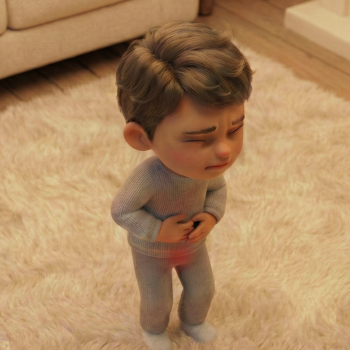
What is Testicular Torsion?
Testicular torsion occurs when the spermatic cord, which carries blood to the testicle, twists on itself. This twist blocks blood flow almost immediately.
Because the testicle is highly sensitive to oxygen loss, damage begins quickly. Pain, swelling, and nausea often follow within a short time. Unlike other conditions, this problem does not correct itself and cannot be treated with medication alone.
Although torsion can occur at any age—including in newborns—it most commonly affects boys and young men between 10 and 25 years, especially during puberty.
Symptoms of Testicular Torsion:
Parents often worry about overreacting. With testicular torsion, it is always better to act early.
Seek a pediatric urologist immediately if your child has:
- Sudden, severe pain in one testicle or the groin
- Rapid swelling on one side of the scrotum
- Nausea or vomiting along with pain
- Lower abdominal discomfort
- A testicle that looks higher than usual or sits at an odd angle
Pain may briefly ease, but it rarely disappears completely. Any delay risks permanent injury.
Why Does Testicular Torsion Happen?
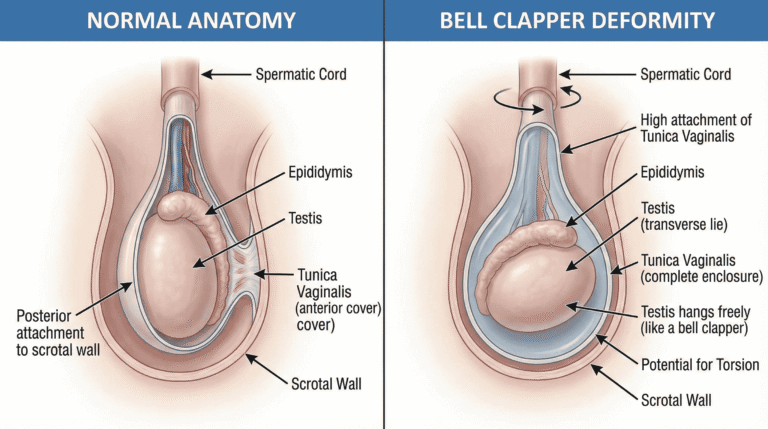
In many children who develop torsion, the testicle is not firmly anchored inside the scrotum due to a congenital variation known as the bell-clapper deformity. Without this natural support, the testicle can rotate freely and twist the spermatic cord.
Torsion may occur:
- During physical activity
- While sleeping
- After a minor injury
In a significant number of cases, there is no clear trigger at all. This unpredictability is why awareness is so important.
How a Pediatric Urologist Confirms the Diagnosis
A pediatric urologist will begin with a focused physical examination. Often, a Doppler ultrasound is used to assess blood flow to the testicle. Blood or urine tests may help rule out infection if the picture is unclear.
When symptoms strongly suggest torsion, doctors may proceed directly to surgery. Waiting for multiple tests can cost precious time.
The reason urgency matters:
- Within 6 hours: up to 90% chance of saving the testicle
- After 12 hours: survival drops to about 50%
- After 24 hours: chance falls to roughly 10%
How Testicular Torsion Is Treated—and What Recovery Looks Like
The definitive treatment for testicular torsion is emergency surgery.
During the procedure:
- Your child is given general anesthesia
- A small incision is made in the scrotum
- The twisted cord is untwisted to restore blood flow
- Both testicles are secured to prevent future torsion
After surgery, rest is essential. Sports, running, and strenuous activity are avoided for several weeks, with a gradual return guided by your doctor.
If blood flow cannot be restored due to delayed treatment, the affected testicle may need to be removed. Even in this situation, most boys go on to have normal puberty, hormone levels, and fertility with one healthy testicle. A prosthetic testicle can be considered later if desired.
In newborns, torsion can be harder to detect because symptoms are subtle and timing is unclear. Any scrotal swelling or firmness in a newborn should be evaluated promptly by a pediatric urologist
Even if pain temporarily decreases, the twist may still be present and blood flow may remain compromised. This false improvement can delay care and increase the risk of permanent testicular damage.
If Treated early, fertility and puberty are typically preserved. Even if one testicle must be removed, most boys still develop healthy hormone levels and fertility with the remaining testicle.
No, Infections usually cause gradual pain, fever, or urinary symptoms, while torsion causes sudden, severe pain and swelling. Because symptoms can overlap, Torsion is often treated as an emergency until proven otherwise.
Yes, Torsion often occurs during sleep and can happen without injury or activity. Any sudden testicular pain—day or night—should be treated as an emergency.

Book an Appointment with Dr. Prabhu Karunakaran
For consultations and appointments:
🌐Visit: https://drprabhukarunakaran.com/appointment/
📱 Book on WhatsApp: 8500550328 (or) 📞 Call for details: 8500550328
Get expert advice and the best treatment options for your child’s kidney and urinary health from Hyderabad’s only dedicated Pediatric Urologist.