



Undescended Testis in children (Cryptorchidism): Causes, Treatment, and Timing
Being told that your baby’s testicle hasn’t reached its proper place can be unsettling. Will it come down on its own? Will surgery be needed? Could this affect future health?
These questions are natural. The reassuring truth is that undescended testis is common, well understood, and highly treatable when managed at the right time.
Understanding Undescended Testis
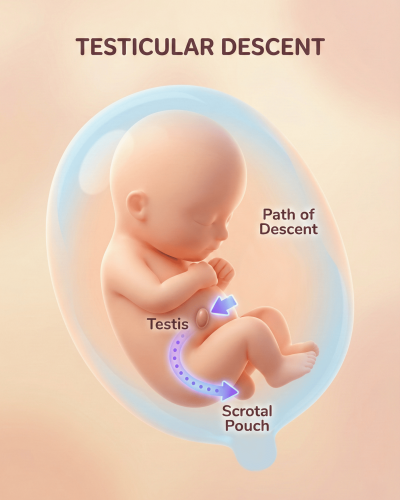
During fetal development, the testis forms inside the abdomen and gradually travels down into the scrotum before birth.
Around 3% of newborn boys are born with a testis that has not completed this journey.
- Most testes descend naturally within the first 6 months
- A smaller number descend between 6 and 12 months
- After one year of age, only about 1% remain undescended
When one or both testes are still not in the scrotum beyond the expected age, the condition is called undescended testis.
Not All “High” Testes Are the Same
In some children, the testis may move up and down — appearing in the scrotum at times and retreating into the groin at others. This is called a retractile (shy) testis.
- A retractile testis is not the same as a true undescended testis
- It usually requires observation and follow-up, not immediate surgery
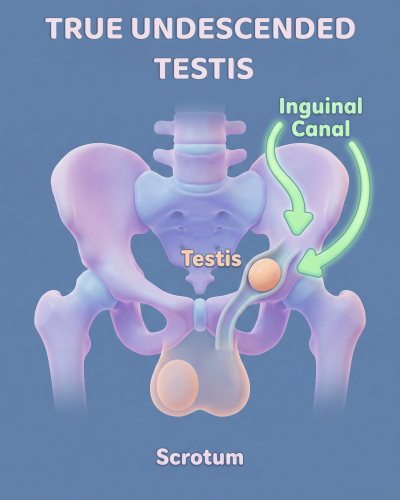
A true undescended testis, however, does not stay in the scrotum and needs medical attention.
Where Could the Testis Be Located?
When a testis cannot be felt in the scrotum, Several possibilities exist:
- Stopped partway in the groin (True undescended testis)
- Positioned outside the normal pathway (Ectopic testis)
- Located inside the abdomen (Intra-abdominal testis)
- Poorly developed or shrunken (Atrophic testis)
- Rarely, absent due to loss of blood supply before birth (Vanishing testis)
Each of these conditions has distinct implications, making expert clinical evaluation essential..
How Is Undescended Testis Diagnosed?
In most children, a careful clinical examination by a pediatric urologist is sufficient.
About 20% of testes are non-palpable, meaning they cannot be felt during examination.
In these cases:
- Ultrasound or MRI usually does not provide reliable answers
- Laparoscopy is the most accurate method for diagnosis and treatment
Laparoscopy uses a tiny camera inserted through the belly button to precisely locate the testis inside the abdomen.
Why Does Early Treatment Matter So Much?
An undescended testis left untreated can increase the risk of:
- Reduced fertility in adulthood
- Higher chance of Testicular Cancer
- Increased risk of Testicular Torsion
- Psychological and cosmetic concerns due to an empty scrotum
The good news?
Early treatment dramatically reduces these risks and protects long-term testicular function.
When Should Surgery Be Done?
The ideal age for surgical correction is between 6 and 12 months. If the child also has an inguinal hernia, surgery should be performed earlier, without waiting.
The Gold-Standard Treatment
The definitive treatment for undescended testis is orchiopexy.
During the procedure:
- A small incision is made in the groin
- The testis is gently freed from surrounding tissues
- Any associated hernia sac is repaired
- The testis is placed securely in the scrotum and fixed in position
This also helps prevent future torsion.
Hormonal therapy may be tried in select situations, but its success rate in true undescended testis is low. Surgery performed by an experienced pediatric urologist remains the most effective and definitive treatment.
Key Takeaways for Parents
- Undescended testis is common in newborn boys
- Most testes descend naturally by 6 months
- A testis not in the scrotum after 1 year usually needs treatment
- Imaging tests often do not replace expert clinical examination
- Early surgery (6–12 months) protects fertility and reduces cancer risk
- Orchiopexy is the gold-standard, definitive treatment
Book an Appointment with Dr. Prabhu Karunakaran
For consultations and appointments:
Visit: https://drprabhukarunakaran.com/appointment/
Book on WhatsApp: 8500550328 (or)
Call for details: 8500550328
Get expert advice and the best treatment options for your child’s kidney and urinary health from Hyderabad’s only dedicated Pediatric Urologist.